
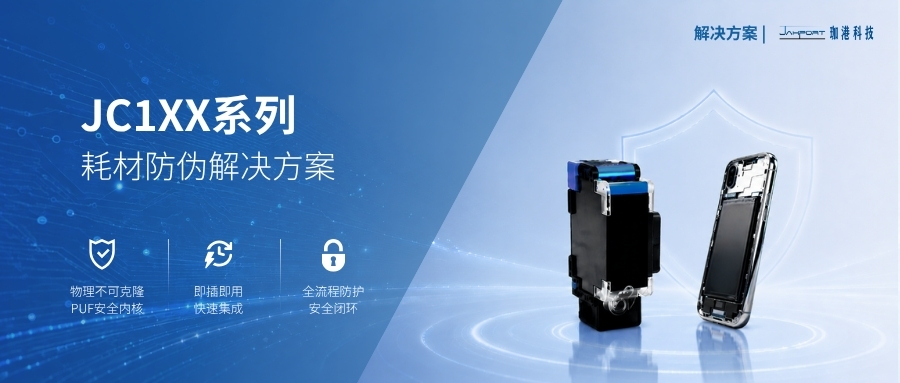
Why Consumable Anti-Counterfeiting Must Enter the "Silicon-Level Fingerprint" Era
From printer ink cartridges, medical device consumables, water purifier filters to smart device accessories, "device + consumable + continuous service" is becoming an important business model in more and more industries. Consumables are not only related to device performance, usage security, and service quality, but also serve as a critical value medium across the product lifecycle. However, unauthorized compatible, refurbished, and counterfeit consumables continue to enter the market, which may introduce device and security risks while bypassing the original product and service systems, breaking the long-established value closed loop built by manufacturers.
At the same time, traditional anti-counterfeiting methods such as QR codes, labels, and serial numbers have limitations of being easy to copy and counterfeit. Business development and external challenges are driving anti-counterfeiting capability requirements for consumables to extend from "external markings" further into the underlying solution layer. Jahport's JC1XX Series PUF Security Anti-Counterfeiting Chips are products defined to address this scenario, leveraging PUF (Physically Unclonable Function) technology that constructs a unique hardware identity based on microscopic physical variations of the chip, moving authentication from "identifying a marker" to "verifying an unclonable hardware identity."
Pain Point Analysis: Why Traditional Solutions Cannot Protect Consumables
- Traditional anti-counterfeiting is essentially a copyable label
Once QR codes and serial numbers are leaked, counterfeiters can perform batch cloning and replication at an extremely low threshold. Traditional anti-counterfeiting methods cannot address emerging security threats. The "one code sold many times" chaos cannot be prevented at the root. Conventional security chips store keys in Flash or EEPROM. Die-delayering attacks and probe/FIB attacks to physically extract keys are not fantasy. Side-channel attacks (SPA/DPA power analysis) can reverse-engineer keys from power curves — theoretically feasible and with mature tooling. Where the key resides, that is where the attacker's target lies.
- Stringent constraints of consumable scenarios
BOM cost sensitivity, power sensitivity, size limitations, and interface limitations — the combination of these conditions continuously narrows the range of applicable chips.
In summary, the ideal solution = unclonable + non-extractable key + low enough cost + low enough power + flexible enough interface. This is exactly the design origin of Jahport JC1XX Series PUF Physically Unclonable anti-counterfeiting chips.
Solution Details: JC1XX Series Consumable Anti-Counterfeiting Solution
Jahport JC1XX Series security chips integrate PUF silicon fingerprint, Chinese cryptographic algorithms, and ultra-low power consumption into a single device. They provide hardware-level unclonable identity authentication for consumables, eliminating counterfeiting at the source.
Silicon-Level Physical Fingerprint (PUF)
Based on PUF (Physical Unclonable Function) hardware-level unique ID, an exclusive "silicon fingerprint" is generated. It is unique from the factory and cannot be cloned. The root key does not need to be statically stored in plaintext form in non-volatile memory; instead, it is reconstructed or derived internally by the chip when needed, thereby reducing the risk of root key extraction through the memory area. Unique from the factory, impossible to clone.
Challenge-Response Authentication Mechanism
A random challenge-based identity authentication mechanism: the host controller sends a new random challenge each time it performs authentication, and the security chip completes cryptographic operations internally and returns the authentication response. The "one-time one-challenge" dynamic authentication approach reduces the risk of historical communication data being reused.
- Dynamic challenge: Each authentication uses a new random challenge value, making historical authentication data difficult to directly reuse for the next identity verification.
- On-chip computation: The authentication key participates in SM2, ECDSA, HMAC, and other cryptographic operations within the security boundary, without exposure to the host controller.
- Flexible deployment: Through the Jahport SDK, the authentication mechanism can be deployed in scenarios such as installation identification, device startup, critical function invocation, and runtime periodic authentication, achieving multi-layer identity checks.
Cryptographic Algorithms: Chinese + International Dual Track
- Native Chinese cryptographic compliance support: SM2 asymmetric algorithm, SM3 hash algorithm, SM4 symmetric algorithm, meeting the mandatory requirements of Chinese cryptographic algorithms in government, enterprise, and critical industries;
- Synchronous compatibility with international algorithms: AES, SHA256, ECC, RSA, RC4, enabling smooth integration with legacy systems and overseas markets;
- Dual-track foundation: As the primary contributor to the SM2 algorithm standard, Jahport has achieved full compatibility of Chinese cryptographic compliance and overseas universal standards on a single chip. The algorithm foundation for consumable anti-counterfeiting is now complete.
Implementation Cases:
- A printer ink cartridge supply chain
Scenario pain point: Compatible ink cartridges posing as original ones cause printhead damage and extremely high after-sales costs.
Solution deployment: JC100-BD1IX (DFN6 3×3mm package) is mounted on the cartridge PCB. The printer host controller initiates challenge-response authentication immediately upon startup. If authentication fails, the print function is locked. Authentication data and ink level are written to the security zone.
Result data: 100% counterfeit identification rate. Replay attacks and cloning attacks are completely ineffective. Consumable anti-counterfeiting is implemented in the ink cartridge scenario, with counterfeit circulation physically cut off.
- A drone brand manufacturer
Scenario pain point: Counterfeit batteries cause in-flight power loss, crashes, and destruction — putting both user safety and device assets at risk.
Solution deployment: JC1XX Series products are integrated into the battery pack. Handshaking with the BMS is performed via LPUART. Non-original batteries are rejected for both charging and discharging. Zero key storage ensures that even if the protection board is physically disassembled, the key cannot be extracted. Challenge-response authentication generates a unique signature for each interaction, eliminating replay attacks. Operating temperature covers -40℃ to 85℃, ensuring stable operation in complex outdoor environments. The ultra-low-power design does not compromise standby time.
Result data: Counterfeit batteries cannot complete identity authentication; the device directly refuses to operate, eliminating the risk of fire and explosion at the source. The solution also ensures the device meets operational identification and regulatory compliance requirements, avoiding flight restrictions caused by non-compliant consumables.
Conclusion
Counterfeit ink cartridges, refurbished medical devices... behind different products lies the same challenge: how to prove "it is genuine and authorized." Jahport's JC1XX Series chip PUF Physically Unclonable technology gives each chip a unique silicon-level fingerprint. When product value increasingly concentrates on brand, technology, and continuous service, anti-counterfeiting should no longer be just about applying a more complex label — it should establish a hard-to-clone hardware identity from the very beginning of product design. To learn how JC1XX can be applied to consumable authentication, anti-cloning, and device identity management, feel free to contact us to obtain the Consumable Anti-Counterfeiting Authentication Solution White Paper.